Arena Shooter Player Analysis
Around summer 2024, I got very into Unreal Tournament 4. I loved the adrenaline-fueled, precise and hectic combat. The more I played UT4, the more confusing it was that I only saw the same 30-40 players every time I played. It seems like this should be a cult classic, instead of relegated to obscure community servers.
Another thing on my mind around this time was this talk by Daniel Cook, which I was lucky enough to see in person at GDC 2024. Cook goes into detail on how the level of trust among a group of players affects their ability to communicate and play together safely.
The heyday of arena shooters was focused around LAN parties, which are a high-trust environment. Online play is naturally a more low-trust environment; and in particular with UT4, most of the players were deeply entrenched veterans whose mastery of the game was a serious challenge to match. I hypothesized that maybe part of the falling popularity of arena shooters is the lack of a well-curated social environment.
Informed by this idea, when my friends and I decided to come together for our DigiPen senior project to make an arena shooter, we intentionally centered the LAN party as our ideal environment for playing Eidolon: Fate of Fools.
On this front, I would say Eidolon was a smashing success. During our several in-person playtests and the end-of-year school LAN party, Eidolon succeeded in bringing a palpable energy to the room.
We had succeeded in building a game for LAN, but after the fact, we set a public Steam release in our sights. As I thought back to my days of playing UT4, I wondered whether it was possible to make some innovation that could increase the trust in the online social environment, and maybe help player retention as well.
I had a few ideas that I thought might work. We could shift attention away from victory as the only meaningful outcome of a match, or build long-term engagement arcs focused on collective progression. My personal favorite idea was to split the matchmaking pool into groups of friends and solo strangers, so that established groups could opt-in to having a self-identified pubstomper in their match.
In order to tell whether any of these designs would make a meaningful impact, I needed to have control data from real players. So, I set out to build a live telemetry pipeline as an independent study for my final design credit.
I collected telemetry from around 250 matches played between September and December 2025. This is not a large sample size, so ultimately the results of this independent study are inconclusive. Still, I surfaced a few interesting insights:
1. The grand majority of players who tried this game were flying solo, not with a group. In fact, the most populated single match only had 4 human players. This supports the idea that the intended social context doesn’t naturally emerge in online play.
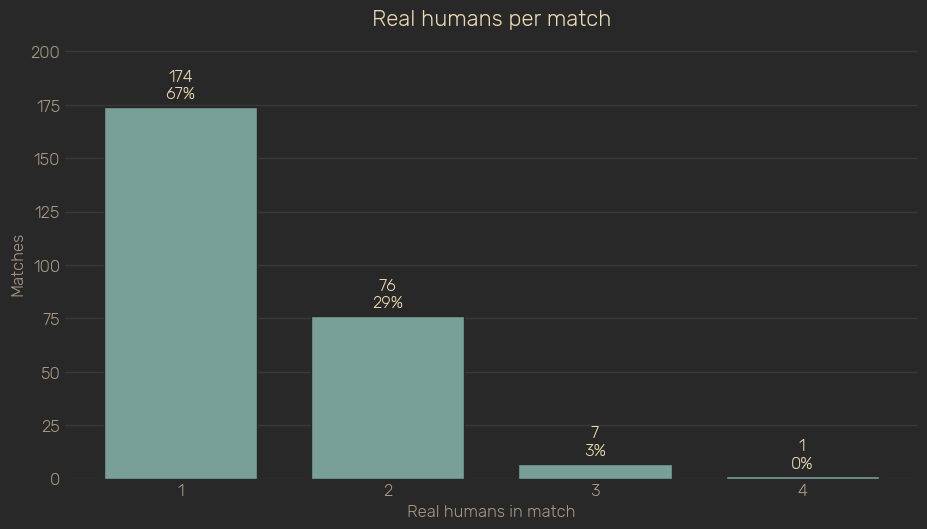
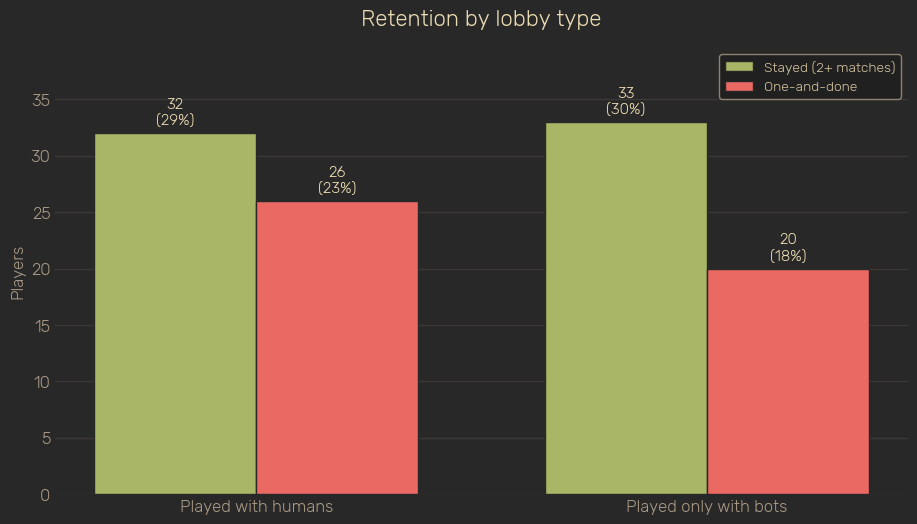
2. The player retention rate was largely unaffected by whether the matches a player played were populated with other humans or only bots. That is to say, someone who played with their friends is about as likely to play again as someone who played alone. This suggests that a social environment actually doesn’t improve the player experience to a meaningful degree.
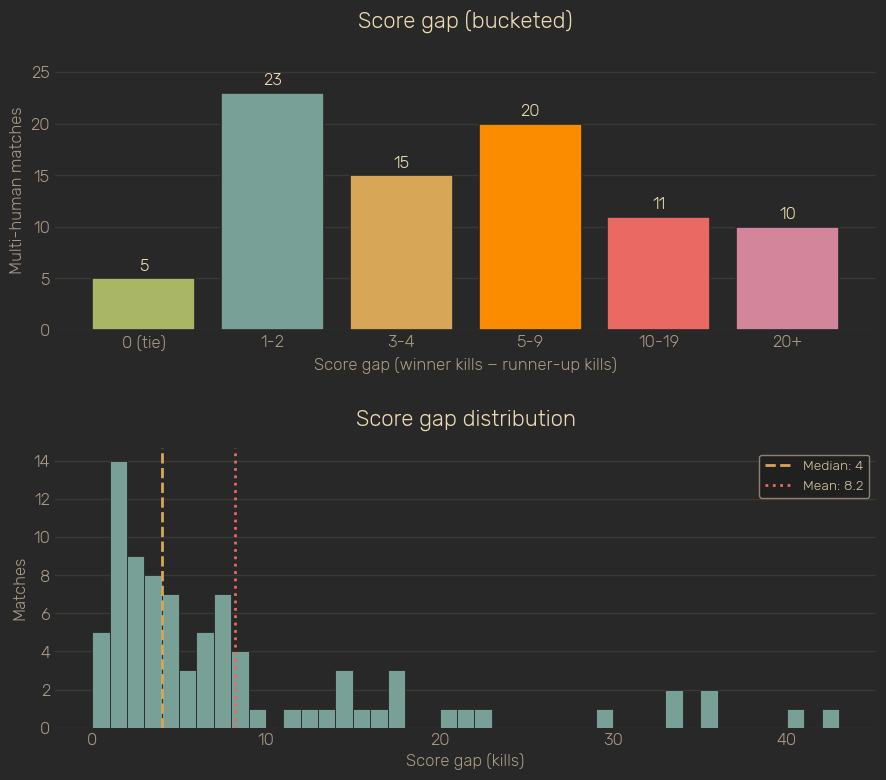
3. The score gaps in human-only matches were mostly reasonable, with some exceptions. I regret that I didn’t get the player feedback form working in time for release - I would have loved to know whether losing badly affected a player’s enjoyment of the game.
Unfortunately, my questions remain unanswered. The process of building this telemetry pipeline took me the full length of the semester, leaving me no resources for building out my ideas for social systems. The data here is interesting, but doesn’t really bring me closer to understanding how players interacted in-game.
On a positive note, I learned a lot from this project. I have a much better grasp on database architecture and telemetry collection, both from a technical and design perspective. Next time I try to analyze player behavior in a game I’m working on, I’ll be better prepared and find more valuable insights.